This is a sponsored conversation written by me on behalf of Audible.
The opinions and text are all mine.
Sure, I could kick off this article with all sorts of glum stats about the lack of women in top spots in business in general and in the IT fields in particular. Heck, I’ve been in tech since I was 15, so I know it firsthand. This is the most shocking of the bunch: women hold just 11 percent of the executive positions in Silicon Valley tech companies. Picture all those boardroom table meetings –and all those decisions being made– with only one woman in the room for every nine men. Blech. It’s bleak, I know.
But it’s getting better.
Want proof? Check out this article from The New Yorker that details the ways the hole in the glass ceiling is getting larger. Yes, there are obvious problems with gender diversity in the tech fields and yes, we have miles to go. But some women have risen to the top and are empowering a new generation of women in the industry with their success.
Not only does gender equality provide diverse ideas, but it also fosters the next generation of female leaders by providing like-minded role models and mentors that are often instrumental to one’s success.
Women need to help women to succeed. And in that spirit, here’s a look at five of the most influential and inspiring women in Silicon Valley; how they got there and their glass ceiling-shattering advice:
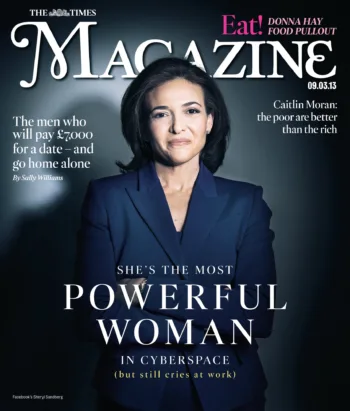
Sheryl Sandberg
“I think now is our time. My mother was told by everyone that she had two choices: She could be a nurse or a teacher. The external barriers now are just so much lower. If we start acknowledging what the real issues are, we can solve them. It’s not that hard.” – Sheryl Sandberg
Sheryl Sandberg is the most vocal and successful advocate in silicon valley (and perhaps the world) for helping women get to leadership positions. Her books Lean In and Lean In for Graduates (which you can listen to via an Audible free trial) are essential reading for any woman in the workforce and/or trying to start a career.
In high school, she taught aerobics and was “always at the top of her class”. She graduated summa cum laude from Harvard and was awarded the prize for the top graduating student in economics.While at Harvard, she co-founded an organization called Women in Economics and Government. Her then-professor Larry Summers recruited her to be his research assistant at the World Bank, where she worked for approximately one year on health projects in India dealing with leprosy, AIDS, and blindness. She then worked with him while serving as Chief of Staff at the Treasury under President Bill Clinton.
After working as a management consultant for McKinsey & Company, followed by a long-time stint as an executive at Google, Sandberg joined Facebook as COO in 2009. She currently serves on the board of directors for Starbucks, the Center for Global Development, Walt Disney Studios, V-Day and Women for Women International.
With her Facebook stock options, Sandberg is estimated to be worth more than a billion dollars and was named as one of Time Magazine’s 100 Most Influential People in the World.
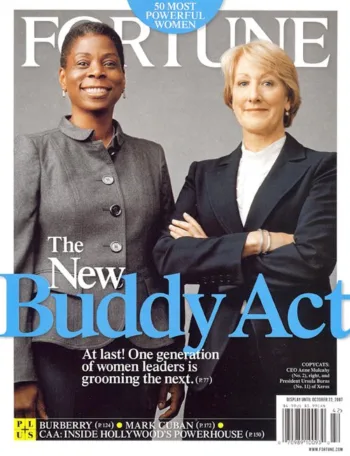
Ursula Burns
Ursula Burns (left)
“You have to have a very strong opinion with some facts and data to stand it up, you have to prove that you are right more times than you are wrong, and then you better walk into the room with something to say because otherwise you don’t really add a whole lot of value to the group. So if you are going to be in the group, I want you to actually come in … and have an opinion. And I don’t mean just opinion like, ‘I like blue or I don’t like blue.’ This is, ‘We have this problem. Here is my take on the problem, here’s what I’ve learned. My experience is telling me this and this is how I would approach it.’” – Ursula Burns
Ursula’s story is a true American dream story. Burns was raised by a single mother in the Baruch Houses, a New York city housing project. Both of her parents were Panamanian immigrants. Burns worked her way up from a lowly intern at Xerox, to executive assistant, and now serves as Chairwoman and CEO of Xerox. Incredible, right? As such, she is the first African-American woman CEO to head a Fortune 500 company. She is also the first woman to succeed another woman as head of a Fortune 500 company, having succeeded Anne Mulcahy as CEO of Xerox. She serves on numerous professional and community boards, and is a mentor to many. In 2014, Forbes rated her the 22nd most powerful woman in the world. Rightly so!
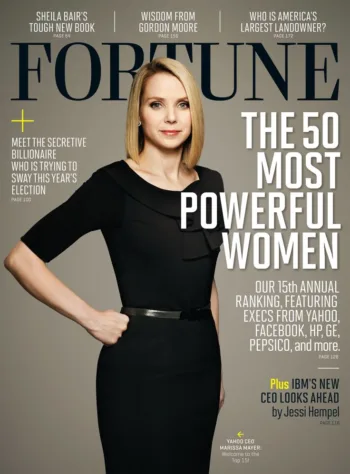
Marissa Mayer
“I always did something I was a little not ready to do. I think that’s how you grow. When there’s that moment of ‘Wow, I’m not really sure I can do this,’ and you push through those moments, that’s when you have a breakthrough.” – Marissa Mayer
As a child, Mayer was “painfully shy”. In high school, she was on the curling team and the precision dance team, and excelled in chemistry, calculus, biology, and physics. She took part in extracurricular activities, becoming president of her high school’s Spanish club, treasurer of Key Club, captain of the debate team, and —get this— captain of the pom-pom squad! Really. They were state runner-up. She also worked as a grocery clerk during high school. Always the overachiever, while studying artificial intelligence at Stanford, she danced in the university ballet’s Nutcracker, was a member of parliamentary debate, volunteered at children’s hospitals, and helped bring computer-science education to Bermuda’s schools. Oh, and somehow still had time to get honors grades.
Marissa Mayer was Google’s first engineer, a Stanford University alumni with a specialization in artificial intelligence who would eventually be responsible for some of Google’s most recognizable achievements. She was instrumental in developing aspects of Google’s user interface, including its recognizable search page, but was also a critical developer for Gmail and Google Maps. While Mayer was working at Google, she taught introductory computer programming at Stanford and mentored students at the East Palo Alto Charter School. She is now CEO at internet tech company Yahoo!, which the Wall Street Journal notes comes with a hefty compensation package valued at $42.1 million a year. From pom pom squad captain / grocery clerk to shaping the way people use the Internet: You go, girl!
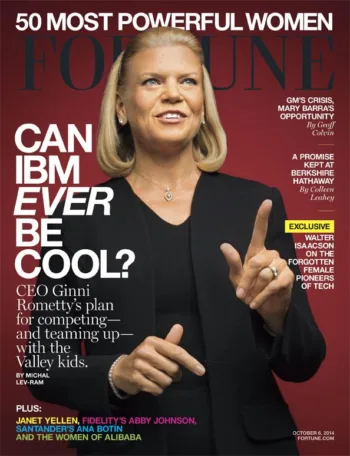
Virginia “Ginni” Rometty
“I learned to always take on things I’d never done before. Growth and comfort do not coexist.” – Virginia Rometty
Once the president of her sorority, and now the CEO of IBM, Rometty has been a practically annual fixture in finance and business magazines’ “Most Influential” and “Most Powerful” lists of notable business people. Her more than 20 years with IBM saw her play an instrumental role in revitalizing the tech giant at the beginning of the century with a transition from hardware to tech services.
Rometty also holds the distinction of also being the first female CEO in IBM’s century-long history. She has been named to Fortunemagazine’s “50 Most Powerful Women in Business” for ten consecutive years, ranking #1 in 2012, 2013 and 2014. An inspiration to women and men alike, she (and the movie Legally Blonde, of course) reminds us that hard work and determination do pay off. Oh yes, and it’s worth noting that she (like I, and many other modern women have) decided not to have children.
Meg Whitman
“Remember that you can do anything you want to do. Don’t let anyone say, ‘You’re not smart enough… it’s too hard… it’s a dumb idea… no one has done that before… girls don’t do that.’ My mom gave me that advice in 1973. And it allowed me to never worry about what others were saying about my career direction.” – Meg Whitman
Meg Whitman has built her reputation in a corporate world still largely run by men. She worked for a number of companies doing brand management and strategy including Disney and DreamWorks, Procter & Gamble, and Hasbro. After that, she served as CEO of eBay. During her 10 years at eBay, she oversaw its expansion from 30 employees and $4 million in annual revenue to more than 15,000 employees and $8 billion in annual revenue.
In 2008, she was cited by The New York Times as among the women most likely to become the first female President of the United States. She is the fourth wealthiest woman in the state of California and she spent more of her own money running for governor of California than any other political candidate spent on a single election in American history. After failing to win the California governor’s race in 2010 she was tapped to run computer giant Hewlett-Packard. She is now the Chairwoman, President and CEO of HP and, in 2014, Whitman was named 20th in Forbes list of the 100 most powerful women in the world.
Change Is Underway
My mom is famous for her “What glass ceiling?” stance. “There’s only a barrier to success if you acknowledge one,” she’d tell me (or something like that). While many would argue that there’s more to it than that, the great thing about the tech world is that you can start a company and, as long as your idea works, it can just as quickly become uber-successful regardless of if you’re a man or woman.
Forbes published some ideas on how to promote female advancement in tech and other STEM fields, which is worth a read. In the meantime, though, I’m grateful these women have paved the way and shown us what can be done.
A writer, artist, and designer since she was young enough to put pencil to paper, Hilary taught herself code and created Urbanette when she was a teenager. Currently, she lives in Monte Carlo, but spent the past decade living in NYC, still considers herself a New Yorker, and visits regularly. She's always traveling, looking for hot new topics, destinations, and life hacks to bring to Urbanette readers.
Traditionally, the glass ceiling was a concept applied to women and some minorities. It was very hard, if not impossible, for them to reach upper management positions. No matter how qualified or experienced, they simply were not given opportunities to further advance their careers. Today, there are many more women and minorities in powerful positions. However, the glass ceiling is still very real. And it’s not always limited to gender or race. Whatever the reason, you have a choice. You can accept your situation and be happy with looking up and not being able to touch what you see, or you can smash the glass with purpose and determination.
It’s a little sad that the main reason why women still can’t get themselves past the glass ceiling is that because at some point in our lives, we will have families and children to take care of aside from our careers. It was like that for me. As much as I want to earn in high figures and work my ass out, I tend to get sidetracked with the demands of my children and the constant need to nurture my family. Both my husband and I work and we do delegate our tasks at home, but there’s a calling in every woman that’s a mother that there really is a line between our priorities and career. SAD, BUT TRUE.?
We use cookies to ensure that we give you the best experience on our website. If you continue to use this site we will assume that you are happy with it.Ok










Let’s be one with those women who broke the glass ceiling.
Your comfort zone isn’t synonymous to success. Getting out of it is.
Work hard, ladies. In time you’ll be able to achieve things you didn’t think you could!
You’re a strong woman that can’t be bound to rules and restrictions. You deserve to be successful.
If you what it takes to reach your certain goal, then there’s no stopping you from living your dream. #NoToGlassCeiling ?
You have to be better than everyone else out there in order to get higher in th corporate world. With or without the glass ceiling.
The glass ceiling is very real. But that doesn’t mean our motivation to get past it isn’t real either.
Traditionally, the glass ceiling was a concept applied to women and some minorities. It was very hard, if not impossible, for them to reach upper management positions. No matter how qualified or experienced, they simply were not given opportunities to further advance their careers. Today, there are many more women and minorities in powerful positions. However, the glass ceiling is still very real. And it’s not always limited to gender or race. Whatever the reason, you have a choice. You can accept your situation and be happy with looking up and not being able to touch what you see, or you can smash the glass with purpose and determination.
Everything is our choice, that’s true. It’s either we make it or break it.
You’re responsible for determining your own career direction. Be proactive and go after what you want, because it probably won’t be handed to you.?
It’s a little sad that the main reason why women still can’t get themselves past the glass ceiling is that because at some point in our lives, we will have families and children to take care of aside from our careers. It was like that for me. As much as I want to earn in high figures and work my ass out, I tend to get sidetracked with the demands of my children and the constant need to nurture my family. Both my husband and I work and we do delegate our tasks at home, but there’s a calling in every woman that’s a mother that there really is a line between our priorities and career. SAD, BUT TRUE.?