
The trick is to focus on the ground. When all you can see is the path underneath your boots, the depth blurs into a solid, rocky, one-dimensional plane, losing all sense of ascent. Still, you can’t fool yourself completely. At 5,000 meters, the breath is ripped from your lungs, leaving hollow, deflated spaces in your chest. I breath deeply, as deep as I can, and it feels like there’s not enough oxygen in all of Annapurna to fill my lungs.
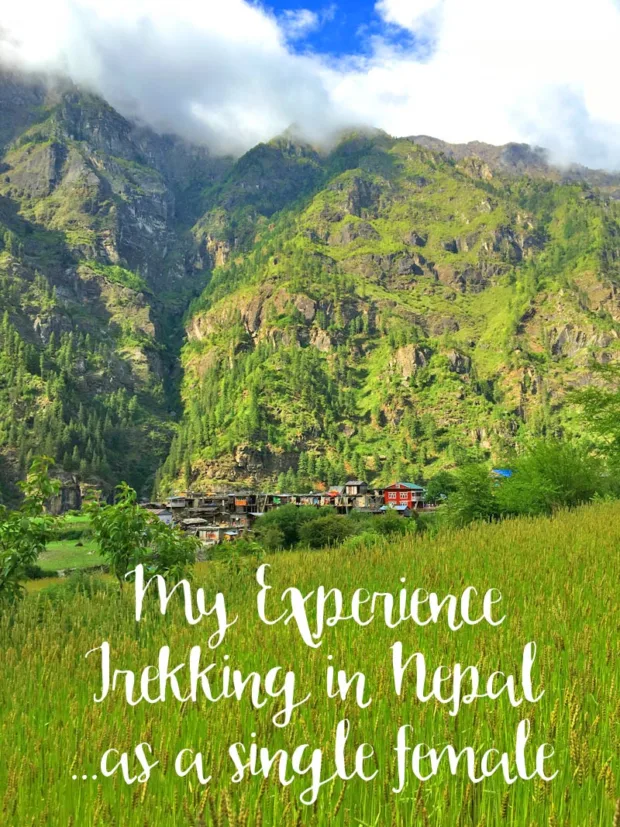
My 13-day trek on the Annapurna Circuit in Nepal was the most physically demanding thing I’ve ever subjected myself to. But it was also the most surreal. I started in Daraphani at 1,860 meters, went through Thorong La Pass at 5,416 meters, and ended in Jomsom at 2,720 meters. I had a backpack filled with thermal wear, a raincoat that made me look like Quasimodo, walking poles for my weak knees, water tablets, snacks, my Kindle, and my laptop (for which I received plenty of teasing).
The unforgiving ascent and the weight of my backpack were making me think twice about my physical strength and my mental fortitude…
On my first day in Daraphani, I awoke to the startling discovery that I had altitude sickness, or at least something that fiercely resembled it. At only 1,860 meters, everyone tried to convince me that this simply wasn’t possible. But the symptoms spoke for themselves… loudly. I was dizzy, my stomach was angry, my head hurt, and the simple task of putting one foot in front of the other was becoming a new personal challenge. I always did enjoy proving people wrong.
I set out for my first official day of trekking the next morning at 9am. The unforgiving ascent and the weight of my backpack were making me think twice about my physical strength and my mental fortitude. I thought of all the thousands of trekkers that had come before me; some soft from desk jobs, some older and frailer. I thought of Cheryl Strayed; her hefty backpack and gallons of water roughing it all the way through the Pacific Coast Trail. Ten minutes into the trek couldn’t be enough to overpower me with doubts. All the same, I started doing mental inventory of the contents of my backpack to decide what I could live without.
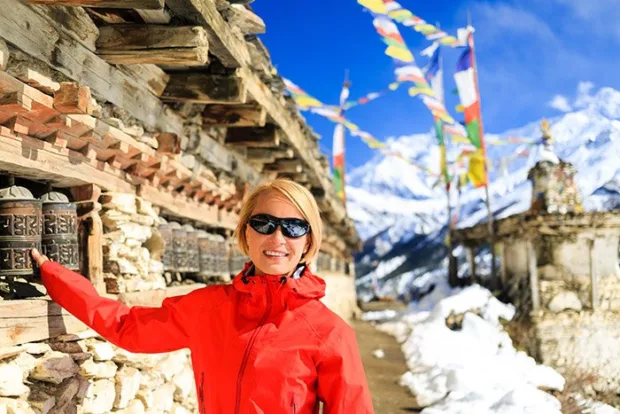
At the next town, I ran into my first trekker, a Russian-Israeli woman also traveling alone. We quickly fell into step, and in the fashion of all travelers, started speaking without the bother of names. We would become trekking mates for most of the rest of the journey.
Inna was an experienced climber who often chose vacation spots based on the quality of the local rocks. She was stronger than I was, more prepared, and infinitely generous. She shared with me the contents of her “kitchen;” a bag filled with snacks including a porridge called tsampa that had both the consistency and flavor of cold mud, but was an epicurean blessing when I was starving and the next town was still two hours away.
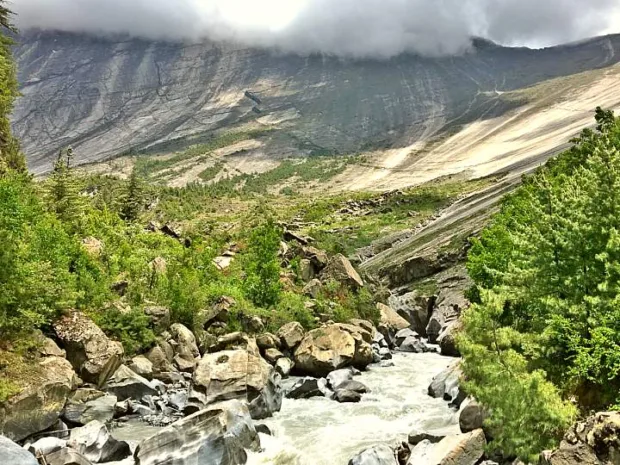
When we had a day of seven to nine hours of mostly uphill walking, she was encouraging. Our mantra was an Israeli phrase she had taught me, “We are in clouds!” The phrase has the connotation that we’re euphoric, but in our case, it was a literal translation.
The hike was exhausting in ways that were previously unknown to me and gave me pain in places that I just didn’t have the motivation to examine. I dreamed of the Lake at Pokhara, and good food. One time I thought I saw the outer corn husk of a tamale on the trail and it occurred to me that murder would be a viable option to get my hands on one.
The Silicon Valley girl that still resides somewhere deep inside my soul made a small scream and tried to call an Uber out of there.
As we ascended higher, the scenery changed. From lush forests and grassy pastures, the landscape slowly gave way to rocky passes, impossible cliff faces, and stunning views of snow-capped peaks. It was the kind of place that made you whisper. Sometimes I would get so absorbed in making it up the next slope without tripping over my own feet that all I could see was the dirt path in front of me. When I looked up, it was often with renewed wonder, as if I had suddenly been transported from the fantasy burrito I had been devouring to a landslide painted gold in the Himalayan light. All of a sudden, the tsampa didn’t taste so bad anymore.
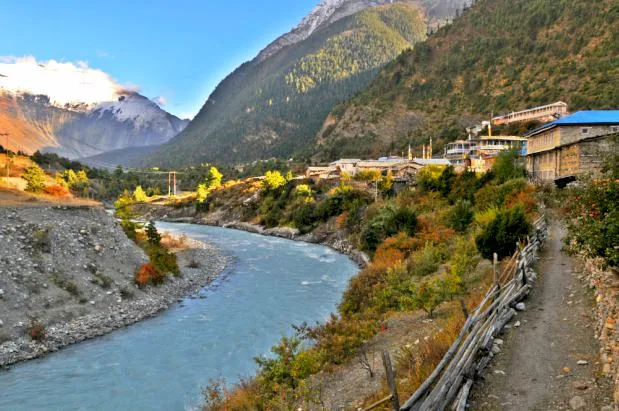
Inna and I began to play a sort of game. The mountains were so immense that it was impossible to know what was around the next bend. Whenever we could see the curve of the trail around the mountain, our mental kinetic energy shot around the bend to guess at the next sight and we would say “I wonder what we’ll see next!” Our imaginations never did quite live up to the impossibly grand cliff face shrouded in ephemeral cloud or the steep valley cut through by time, water, and glaciers. The views took away what little breath you had available and left you standing silent and numb to the weight of your backpack or the soreness in your legs. It was the best anesthesia.
On the fourth day, when we reached Lower Pisang at 3,200 meters, we were greeted with the usual “Namaste” and the news that there was no electricity in the entire town for the foreseeable future.
The Silicon Valley girl that still resides somewhere deep inside my soul made a small scream and tried to call an Uber out of there. Somewhere she’s still wandering around in the dark recesses of my mind, holding her phone up to search for the best WiFi signal. But at that moment, trekker me took over. I swallowed and contented myself to a night of staring at mountains and reading The Snow Leopard.
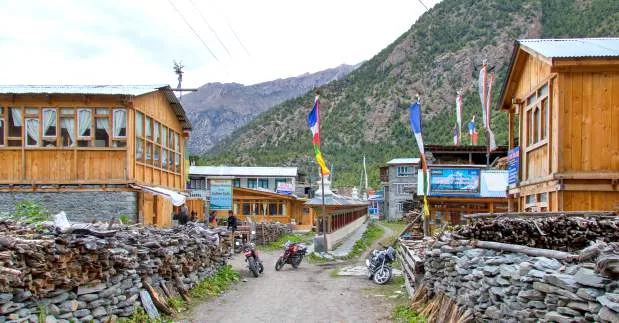
On the fifth day, going from Lower Pisang to Manang, Inna and I decided to split up for the day. She wanted to take a more scenic route that featured a harder climb and better views. Judging from my extraordinary struggle of the last few days, I decided to take the road most traveled. Along the way I shared a cup of what tasted like sugar with a bit of tea mixed into it with a Nepali-Tibetan man named Karma. Karma comes in all shapes and sizes, and this one wore an electric green Slipknot hat. I desperately wanted to subject him to the musical renderings of Psychosocial. However, with no wifi available, I thanked Karma for the sugar, and went on my merry way.
Karma comes in all shapes and sizes, and this one wore an electric green Slipknot hat.
At one point, I walked up a hill with a sharp wind. The wind whipped away the low-hanging clouds like a curtain and I saw the snow-capped peaks of mountains arranged before me as if I had stumbled upon a private peep show. The were grand and vulnerable and self-assured. The snow on their peaks was the source of the clear stream running beneath the old wooden bridge I stood upon. They were close enough to touch, but I knew without trying that they were mirages that would move further away the closer I got. I could never get close enough to something so impossible.
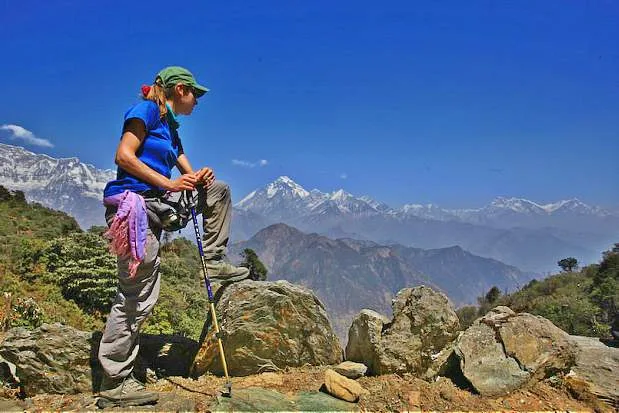
I heard laughter and was startled to find that it was coming from me. I shrugged off my backpack and leapt around, leaving myself breathless and heaving from my small happy dance. I sat on a rock and stared and marveled and was reminded of a quote I had read in The Snow Leopard: “How wondrous, how mysterious! I carry fuel, I draw water.” The statement is self-sufficient and self-sustainable. It is all it needs and can lend itself to all situations. I carry fuel, I laugh at mountains.
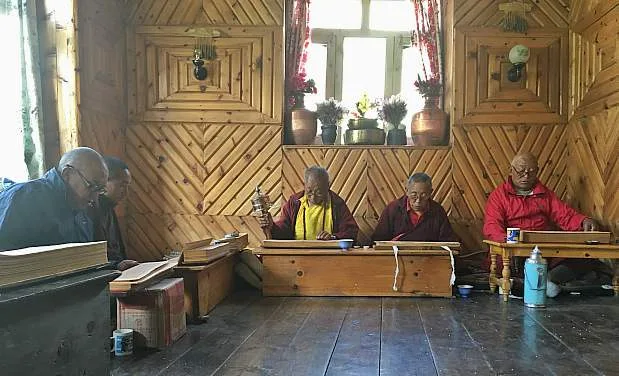
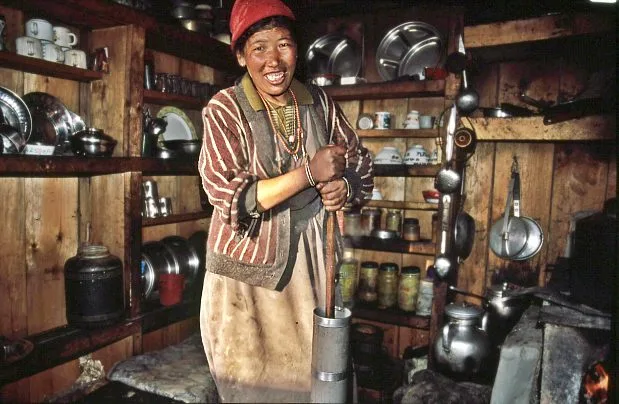
In Manang, at a height of 3,540 meters, it’s time to acclimate. Every trekker has to stay and rest at least a day to adjust to the altitude. Inna and I stayed at a teahouse called Nilgiri Guesthouse that (surprise!) had no Wifi. However, they did have electricity, and more importantly, a group of Tibetan Buddhist monks who read from meditation books every day from 8am until 5pm. Our socially awkward teahouse proprietor explained that they have the monks come every year for five days to bless the family and ward away bad spirits. The monks explained that they meditate for the wellbeing of all mankind. They were chanting for my health, Inna’s happiness, and the welfare of human beings from here to Haiti.
From Manang you can deviate from the main path and do some side treks. One of the side treks is Tilicho Lake, a lake that is neither the highest in the world nor the biggest, but meets at the corner of large and altitudinous to claim the title of the biggest, highest lake on the planet. It was a two-day trek off the main Annapurna Circuit. We would go first to Shree Karkar at about 4,000 meters, and the next day to Tilicho Lake at about 5,000 meters. It would be a 1,000 meter hike.
At Shree Karkar, we saw the largest grouping of trekkers we had seen in the last six days. June is the start of Monsoon season so most trekkers avoid the trail during that time. However, all we saw was clear skies, sunny weather, and very few trekkers. We met two Norwegian guys and a Canadian girl who were equal parts sarcasm, dirty jokes, and boundless compassion. They were also heading to Tilicho Lake the next day so we all decided to go together.
During our journey, I learned about Buddhism and intention from Bjørn, proper elephant care from Jayne, and developed a psychopath serial killer character known as Nepali Bob with Erlend. Nepali Bob had an entire album of homicidally remixed 90s songs by the end of the trip, courtesy of Erlend. It was a surprising motivator for conquering mountains.
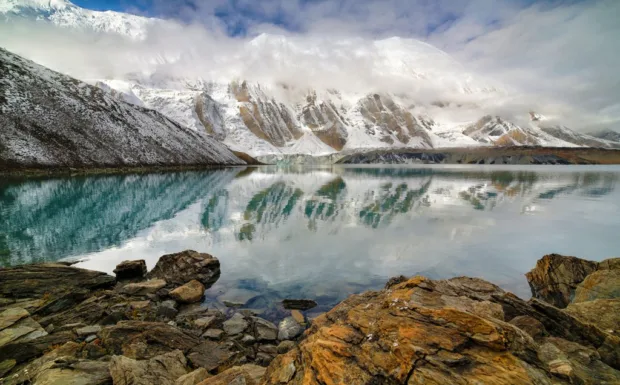
The day trip to Tilicho lake became a 14-hour hike there and back. Every step up the steep mountainside was a double-edged sword because it took you closer to the destination but also farther away from much-needed oxygen. Signs warning of landslide areas stated the obvious as we picked our way over trails that were no more than slight indents in the crumbling mountainside, and every footstep sent a flurry of small stones cascading down 300 meters to the sharp crease of the river below. Bjørn, being afraid of heights, said mantras on his meditation beads and covered the side of his face with his jacket.
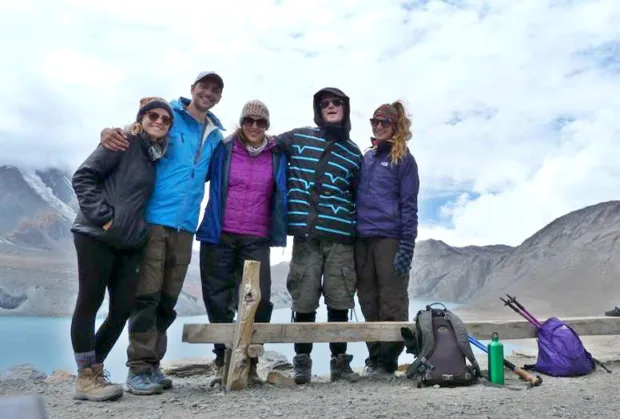
The hike became not only physically strenuous but mentally demanding as well. The heights, depths, and bends of the mountainsides mirrored the folds of my mind until I was walking through a map of my own psyche. Every curve in the landscape not only revealed a fresh, astonishing sight, but a spark of an insight as well, or the dark shadow of a new doubt. Mountain peaks jumped out around bends, wind-sculpted sandstone stood guard like stoic sentinels, a herd of blue sheep rushed the craggy mountainside. Down at the bottom of the valley, two rivers met: one clear and blue, another dark from gray, glinting silt. They joined forces, became stronger, and eventually made their way to the holy Ganges.
At Tilicho Lake, at a height of 5,000 meters, I felt drunk and giddy.
I laughed at something or other, loud and clear over the vast expanse of glacier-blue water and felt the immense mountains absorb the sharp shock of it. It felt good to laugh in a space that was too big for comprehension, like I was laughing on the edge of the cosmos.
When we weren’t scaling mountains, we were resting in the teahouses along the way. We played card games, ate high-calorie meals, read books, and took cold showers. Things that were not luxuries before became so. A bucket of cold water was something to be grateful for, as it meant you could wash the dust and sweat off at the end of a hard day. The chance of electricity meant not having to wear a headlamp when you had to pee in the dead cold of night. “Dirty” became a relative term. I had four pairs of socks and would sniff them each day to judge which had been aired out the most recently and therefore were the least foul of the bunch to wear for the next day’s hike.
Over Thorong La Pass at 5,416 meters, Erlend and Bjørn carried some of the heavier items from my, Inna’s and Jayne’s backpacks. At this point my laptop was merely dead weight; a heavy battery pack for charging phones, and Bjørn carried it up the pass for me. That morning we had all shared the food from our backpacks, made sure all were feeling well, and set off at a pace that was conducive to everyone’s physical strength. When Jayne looked like she was inebriated at our first stop at High Camp, Inna made her eat raw garlic with her typical Russian mother-bear command: “You will eat this.”
The day turned out to be 11 hours of 50/50 uphill and downhill. It was the only time it rained during our trek and I wore my Quasimodo raincoat that hardly protected me and my backpack from what eventually turned into cold, pelting hail. However, when we reached the pass at 5,416, the day was clear.
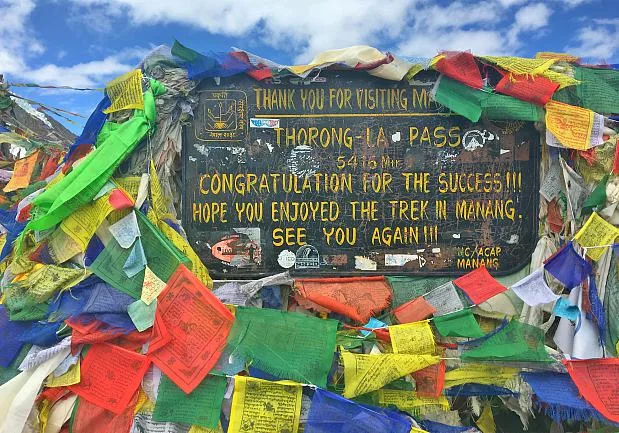
Thousands of multicolored prayer flags were wound around the signs proclaiming our victory: “Congratulations for the Success! Hope you enjoyed the trek in Manang. See you again!” Previous trekkers had covered the hillside in arranged stone messages, declaring love or the dates of their arrival at the pass. On the wall of the small wooden edifice were stickers of travel groups, photos of hikers, and the insignia of the “Lost Boy” that had been scrawled on surfaces all the way from Daraphani to Thorong La Pass. We celebrated with Snickers bars as Erlend and Bjørn fought to be the first to piss at 5,416 meters.
During the trek, I learned the Buddhist notion of impermanence. It lends to every moment the impression of exquisite present tense. The mountains of the Annapurna range, behind and before us, above and below were the most eternal images I had ever laid eyes on, but they gleaned their beauty not from their infinity, but from their impermanence, and from my few moments of time in their company. One day, the snow will melt, the mountains will crumble, the Lost Boy will find his way, and every exultant moment will pass. The most beautiful thing of all is the memory of standing in reflection of the Annapurnas and knowing that the moment is only the imprint you see of light once it’s been shut off.





Thanks for the positive notes and encouragement for those who love trekking and want to visit Nepal. This article is a real gem. ??
Beautiful.. I would like to visit Nepal. Would be my first trip but i don’t have anyone to go with, and I’m notas brave as you… Any suggestions or advice on this trip?
I found your post very interesting and exhilarating. I want to go trekking to Nepal this year or next year with a friend but we want to explore the less-developed areas. We would like to carry our own equipment like tent, food and others) so we are not restricted to trails with lodges/teahouses on the way.
Is this a popular form of trekking in Nepal? Are there any permits/registration formalities for this kind of trekking? Would you recommend any particular treks or areas of Nepal?
Awesome post! Reading it feels like I am already there, especially looking at those photos. Only wish I’d seen this post before I made my bucket list for this year.
I feel you have a nice time… I’m honestly afraid to try it myself, I feel it’s dangerous ???
What a brilliant article!! Really encouraging for single travellers. It is always a good time to go to Nepal and even more after the earthquake. Nepalese people are one of the kindest people I met during my travels and what a country! It thought me a lot in terms of how the concept of “living” could have such different perspectives and what concepts are more important over the others. Beautiful country, beautiful people.
Your article brought back the excitement! I was in Nepal for first time in September 2013. It blew my mind. I want to go back for more mountain hiking/trekking. I went there alone (with smartphone-gps with extra large non-standard battery). It was great a great experience. Connection with nature and with myself. Yes, some moments were scary (like attack of leeches, but fortunately I did read about that before trip or moment when I fell some steps down on trail in rainy weather), but I don’t regret traveling alone. Next time, I’ll try trekking with friends.
I really enjoyed this article, especially since I am leaving for Kathmandu in less than two months! I actually was supposed to take this trip in May of last year, just a few weeks after the earthquake hit. I’m glad to hear recovery efforts are going well.
Nepal has always sounded magical. Hearing that the local people there are still so optimistic in the face of their hardship is so refreshing. I’m glad you gained some perspective by being there and interacting with them. I hope I get to be lucky enough to do it one day as well.
Nepal is always a place that has fascinated me and thanks to you Ariana, I want to go even more now. You might like the book The Lie by C L Taylor as this is set in a fictional mountain and retreat but still captures the remote setting. Made me thankful the retreat was fictional but the setting is still a place I’d like to go!