
Recently, the farm-to-table movement has taken off. But what does it really mean? Clearly, “eat local” means “support your local farmers”. But “farm-to-table” is a very open-ended term, and while it’s often assumed to mean humane or organic, it can just as easily mean factory farmed and GMO. “Sustainability”, although it has a relatively narrow definition, is a dangerously misused and unregulated term.
We recently visited Shelburne Farms, the leader in agritourism and farm-to-table education. While we loved our experience at the Inn at Shelburne Farms, we feel we’d be remiss if we didn’t continue our review by writing an open letter to the organizers at Shelburne Farms, and to all those who are involved in farm-to-table and sustainability education.
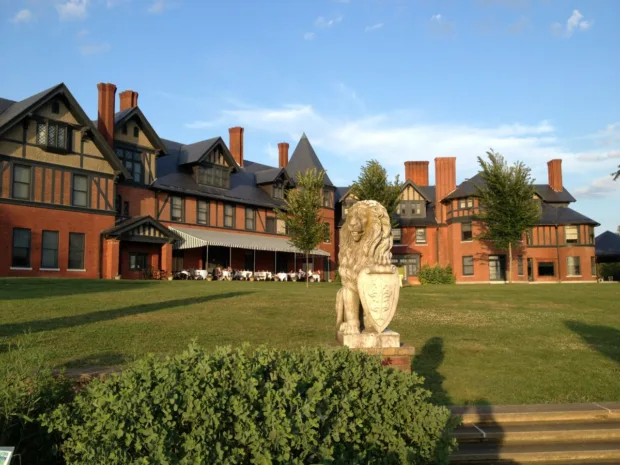
Shelburne Farms’ Mission: What They Do
Shelburne Farms is a working farm and luxury inn in Vermont, and the leader in farm-based sustainability education. Their mission is: “Educating for a sustainable future” and teaching tourists, kids and teachers so they will leave “understanding where food comes from”. The #1 thing they do is “offer learning experiences that inspire young people to make informed decisions to build a sustainable society”, and “big ideas of sustainability underpin all our education programs.” They hold “Education for Sustainability Summits” and are the “backbone organization” of the farm-based educational groups Farm-Based Education Network (with 2700+ members), the Sustainable Schools Project, and several other similar organizations. Which says to me: They should know better.
Shelburne Farms is the leader in America when it comes to educational agritourism. They’ve started a nation-wide trend of farm-based sustainability education.
The Fantasy
“Educating” that the 1400 acres of rolling hills, where only 125 lucky cows get to graze, is “where food comes from”, or that it’s representative of what a “farm” that produces beef, sausage and other edibles is like, is akin to taking a foreigner on a tour of the top private school in Manhattan and leading him to believe that’s how education is done in America. Period.
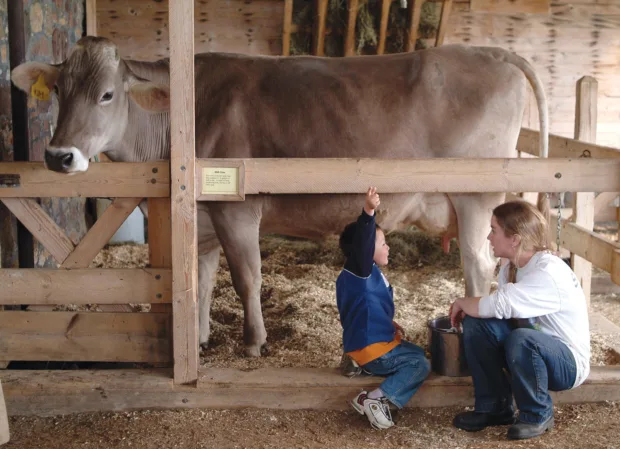
In fact, teaching people that the animal farming at Shelburne Farms is anywhere close to “sustainable” is incredibly misleading. According to their most recent Form 990 (non-profit IRS form), their revenue from livestock products was less than $250k, while it cost nearly $4 million to run the farm. They need donations to sustain.
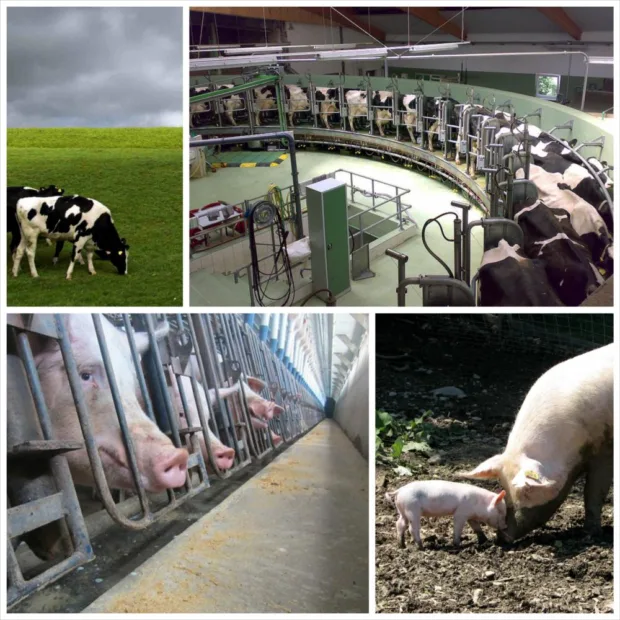
That gives you an idea of why almost all farms nowadays are factory farms, where animals are crammed into a concrete building so tightly that they need constant antibiotics to keep from getting sick. Not only that, but they give them growth hormones to make them grow freakishly and unnaturally fast so the turnover is higher. This is what they should be teaching people at Shelburne Farms.
In short, teaching people that this is “where food comes from” a destructive fantasy and, frankly, feels like beef-industry propaganda. If you think that sounds harsh, consider this: If you were a lobbyist for factory farmers, wouldn’t you do whatever it took to put a picturesque and “certified humane” farm like Shelburne Farms in charge of educating kids and teachers nationwide about “where beef comes from”? Me too.
As a side note, the Market Garden at Shelburne Farms grows produce (fruit and veggies) that is all organic. They do not use GMO seeds, herbicides or pesticides. Organic farming is the only eco-friendly and sustainable way to farm produce, and you can taste the nutritious goodness with every bite.
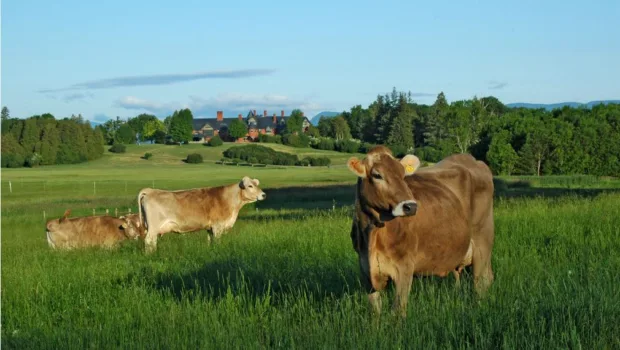
The “Happy Cows” at Shelburne Farms and Elsewhere
The secret truth of farming is that it’s pure fantasy to think that beef comes from “Happy Cows”. Even at Shelburne Farms, there is no such thing; and there certainly isn’t at the 99.5% of farms that are not “Certified Humane”, which is likely where your next steak is coming from. The truth is that in order for you to drink a baby’s milk, the baby has to be removed. That cereal, pastry or cheese is full of milk that was meant for some cow’s baby. Instead, the baby is removed from the mother, leaving both the mothers and their babies wailing for days and sometimes weeks, filled with separation anxiety. Then, the baby is killed (not on-premises; at Shelburne Farms they are slaughtered by a separate company), and his or her body is sliced up and put on a human’s plate to eat. That, ladies and gentlemen, is how you get milk, butter and cheese. (*more about all that)
One of the things Shelburne Farms is particularly naive about is the fact that telling people to be involved in their local farms is going to result in about 0.5% of the people they educate actually doing that. What percentage of people have the gumption or time to visit every farm before they eat every piece of meat, and talk to the owners to make sure it’s humane?
Imagine this: you’re at a dinner meeting at Ruth Chris Steak House. You decide you don’t care about asking where the beef came from in front of your boss or client, but the waiter says he doesn’t know. So you insist and the waiter asks the chef. They tell you it’s from a restaurant food distributor. So then you look up the company on the internet. They don’t say where it comes from (because it’s a hell-on-earth factory farm), so you call them, but they’re closed. Dead end. But seriously — what percentage of people would continually go through that effort, especially with so many dead-ends? Besides, even if people had the will to ask, websites can be decidedly misleading and waiters can be decidedly ignorant.
A Truly Sustainable, and Humane, Future
If it were up to me I’d change their educational programs to be about the sustainability of plant-based, beef-less, and organic diets. I’d teach people about how GMO pesticides are poisoning people and destroying our water and fields. I’d tell the hundreds of people they influence daily that the easiest and most effective thing that we, as human consumers, can do to support sustainability is to stop consuming cow flesh and milk. Now, I know that sounds extreme, but hear me out. These are the alarming facts about farming, and what I’d like to see Shelburne Farms start preaching:
- Cows farts (no, really) are the #1 cause of greenhouse / climate-disrupting gases. It may sound crazy, but cow’s farts are essentially destroying the entire planet.
- According to the EPA, the runoff from factory farms pollutes our waterways more than all other industrial sources combined.
- Making room for cow grazing land is the #1 cause of habitat and rainforest destruction, pushing other species into extinction daily.
- According to the United Nations, raising animals for food (including land used for grazing and land used to grow feed crops) now uses a staggering 30 percent of the Earth’s land mass.
- Livestock grazing is the number one reason that plant species go extinct.
- More than 260 million acres of U.S. forest have been cleared to create cropland to grow grain to feed farmed animals.
- According to scientists at the Smithsonian Institution, the equivalent of seven football fields of land is bulldozed worldwide every minute to create more room for farmed animals.
- According to Greenpeace, all the wild animals and trees in three million acres of the Amazon rain forest in Brazil are destroyed in one crop season alone, in order to grow crops that are used to feed chickens and other animals in factory farms.
- One of the main crops grown in the rain forest is soy—in fact, much of the enormous amount of soy that is needed to feed the world’s farmed animals now comes from the rain forest. (The soy that is used in veggie burgers, tofu, and soy milk in the United States is almost exclusively grown domestically, not in the Amazon.)
- To grow one pound of beef, it takes 2400 gallons of water and 13 pounds of food for the cow, while growing 1 pound of wheat only requires 25 gallons of water.
- You save more water by not eating a pound of meat than you do by not showering for six months!
- Nearly half of all the water used in the United States goes to raising animals for food.
- It takes more than 11 times as much fossil fuel to make one calorie from animal protein as it does to make one calorie from plant protein. Raising animals for food pollutes and gobbles up precious energy.
- If we simply ate soy and other plant foods ourselves instead of feeding them to farmed animals, we would not need to raise nearly as many crops, and we could eliminate the need to decimate the rain forest.
- If cow grazing land was used for crops instead, we could easily feed the entire planet with its produce.
- Raising animals for food is grossly inefficient because while animals eat large quantities of grain, soybeans, oats, and corn, they only produce comparatively small amounts of meat, dairy products, or eggs in return.
See? Raising cows works out to actually be the direct opposite of sustainable or eco-friendly farming.
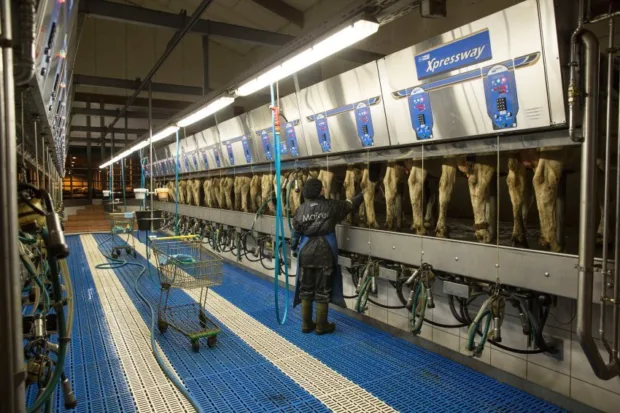
According to the American Council on Renewable Energy, at least 100 farms across the country are doing something truly sustainable – something which should be not only taught at places like Shelburne Farms, but practiced. These farms are cow manure-powered facilities. Yup, you read right. They use about half of the manure (ie. poop and urine) that would otherwise pollute, and convert it not only into more than enough power for their entire farm, taking them off the grid, but often enough to sell back to their county. These farms are being touted by politicians as a way to curb nitrate levels and water pollution, and a produce renewable green energy stream.
“(The system) might be a breakthrough, a breakthrough in a challenge that has faced the dairy industry throughout this country and in California,” California Democratic Rep. Jim Costa told the Merced Sun-Star. “What we’re really talking about here is protecting water resources, protecting the air quality and climate and creating a renewable energy stream,” Costa added.
If you’re curious to find out more, research the groundbreaking Antonio Brasil Dairy farm in northern California.
The Future
It would seem to me that the “big ideas of sustainability” that Shelburne Farms says they teach “educators and schools” both on their “farm-campus” and off-site “that inspire young people to make informed decisions to build a more sustainable and just society” should be, simply: “Go vegan!”
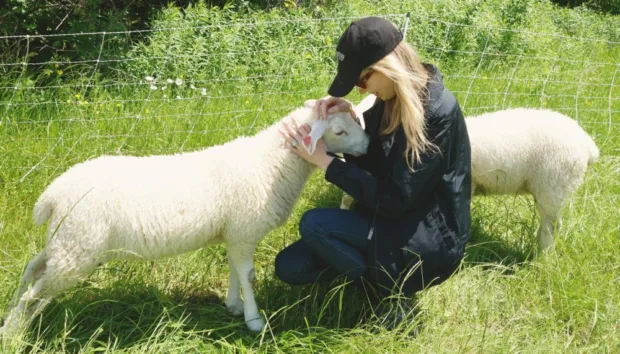
Shelburne Farms recently released a cookbook for schools that is full of seasonal and meatless meals. Their marketing talks about educating people about “sustainability” and “the change we want to see in the world”. Perhaps this is the first step in Shelburne’s gradual conversion to an animal sanctuary where they educate about the true reality of farming, and how we can all do our part for a truly sustainable society by consuming less meat and eating organic — and knowing why we’re choosing to do so. Now, that’s something I would want to donate to!
With the Internet and social media spreading the real facts about all types of farming, and plant-based/meatless diets being the fastest-growing segment of the food industry, this kind of thinking is the only future our small planet can afford.
Want to learn more?
- Hope’s Edge is the updated book by the authors of ‘Diet for a Small Planet’ which, in the 70’s, was the first book to talk about the realities of livestock farming and sustainability.
- The Omnivore’s Dilemma is a super-famous bestseller that explains, in an entertaining and enjoyable-to-read way, exactly what went into our food and where it all really comes from.
- The Pig Who Sang to the Moon is a great book about the emotional lives of farm animals.
- The China Study is a massive bestseller, and an essential read for anyone who wants to be educated about the health impact of animal proteins in their diet.
- That’s Why We Don’t Eat Animals is a sweet and beautifully illustrated book for kids (check out the author’s two other children’s books about being kind and vegan).
- Free From Harm is a great website full of lots of articles.
- Curious about going vegan? Check out Vegan Kit. They’ve got a bunch of great videos that are worth watching.
- Look up a man named Harold Brown, someone who speaks with experience, as a former beef and dairy farmer who is now a vegan and animal rights activist, and the subject of the documentary film Peaceable Kingdom: The Journey Home.
- Eat Like You Care gives a solid argument for going vegan.
- Gene Bauer, the author of Farm Sanctuary: Changing Hearts and Minds about Animals and Food is doing the type of truly inspirational work I wish Shelburne Farms was doing.
- A couple of great movies to watch are: Speciesism and Peaceable Kingdom.
- My Gentle Barn: Creating a Sanctuary Where Animals Heal and Children Learn to Hope is the story of how and why a 3,000-acre working farm was converted into a sanctuary.
A “funny” 50’s sitcom-style video about “Humanely Raised” and “Cage Free”, etc. meat:
…a ground-breaking film that has gotten rave reviews (you can watch it on Netflix):
…and if you really want to know where 99.5% of meat comes from:
Read more: 6 Tips for Health-Conscious Meat Eaters




I totally agree. Hunting even made certain animals go extinct all over the world! Its such a shame that we are said to be the smartest animal on the planet earth but instead of using our brains to help another animal to survive, we became the monster they fear. We are the one killing them. I remember one time I was watching videos on youtube and it’s a horrible thing to see people killing other animals not to eat them BUT just for FUN! I really don’t know whats with these human beings.
The most common justification I hear for vegetarianism is “It’s wrong to kill an animal for food.” Of course, there are other motivations, such as health, religion, environmentalism, preventing suffering. But the moral wrongness of killing an animal for food is the probably the most common, at least in my experience. I’ve found it surprising that people so rarely acknowledge that vegetarians do kill millions of animals for food. If you buy eggs or milk or cheese, it’s true in theory that the dairy cows and laying hens don’t have to be killed in order to supply you with those products, but in practice, they are. Being a vegetarian simply isn’t enough.
Whether you believe there is something wrong with killing animals or not usually comes down to whether or not you think some forms of life are superior to others. In other words, if you believe that all life forms have equal value, then you will not mind killing animals for food – or killing plants for food. If you believe that sentient animals are superior to other forms of life, then you will believe that killing them is wrong, but killing plants is not wrong. The justifications for each point of view are quite irrelevant – that’s the summary of the matter.
as an Asian, I strongly agree with this sentiment. we eat anything that moves as the popular stereotype says, but they don’t know how we treat the ingredients as we cook them, they don’t know the respect we give to every grain of rice, every part of an animal, and every ounce of life it has given us as we prepare and eat the meal. life is taken so another can survive, may it be plant or animals. however, it is our duty to not waste any part of the animal as a sign of respect for it.
I think it is not right to kill an animal for food. I believe in the value of all life and that no one really has the right to take one. Especially since we don’t need to eat animals in order to get nourishment.
The animals we eat do not just exist in isolation waiting for us to eat them. They eat grains too. In fact, almost all the animals we eat are ones kept caged by us inside desolate barns and kept fed by us on grains we grow just for them. We grow soy, corn, wheat, barley, sorghum and other grains on vast tracts of land. all of which also cause large numbers of deaths. Meat consumption remains an inherently inefficient process in which we grow far more crops to feed to the animals we eat than we would need if we ate the crops directly ourselves. It’s an ecosystem of a prey and predator cycle.
Although I am a vegetarian myself, I do not impose my opinion upon others and force them to conform to my ideal lifestyle. I understand the societal influences and the desire to “fit it” deter many people from living a plant-based lifestyle. I do, however, believe as environmental issues and overpopulation increase in the future that a need for a more sustainable lifestyle will arise (whether it relies on plants, synthetic lab-grown meat, or something else). Our future generations may view eating animals as we view slavery and genocides.
I don’t think it’s wrong to eat other animals. If it was then why do so many different species of animals eat each other? If they didn’t they would not survive. Lions cannot live on grass, the same way we cannot live on rocks and dry twigs. Some human beings can live on just plant life, but if we are questioning whether it’s right to eat animals or not, we can question if it’s right to eat plants. Who says plants don’t suffer when we pluck them up to eat them? After all, we do call them LIVING THINGS too, right?
say it louder for the people at the back, seems like not all can hear you hunny.
they say its ethical because they don’t scream in pain if we chop them up or pull them from the ground or break them apart. they say it’s better to feed on plants because they don’t have faces. but they don’t see that plants have lives to just like the animals they oh so religiously protect.
Its human morality that separates us from animals. But just the fact that we do these to animals doesn’t really separate us from them.
A vegetarian spares the lives of a certain number of animals each time he or she chooses to forgo meat for vegetables, fruits, grains, legumes and nuts. These animals, of course, are not necessarily ones who continue to live because a vegetarian chose not to eat them. The way a vegetarian saves animals is by reducing the demand for meat and causing fewer animals to be born into a harsh life owned by the meat industry, where callousness abounds and mercy is scant. That’s a good headstart.
Honestly, the problem with switching to a vegan lifestyle is that it’s expensive. Not everyone has the luxury to buy vegan alternatives for food. Normal people who don’t have enough money for this will just end up being malnourished because of their lack of alternatives to have a nutritious diet. They can’t just live on salad alone. This is a reality too, no matter how much some people actually think that killing animals for food isn’t right.
I have the same concern. I’m aware of how the dairy and meat industry is, but I can’t just switch to a lifestyle I can’t afford.