
We live in a diet-obsessed society. I started my first weight loss plan during my pre-teen years when I felt fat for the first time. Constantly switching from fad diet to fad diet, I was hoping that this would one be the key to weight loss. It didn’t take me long to notice that everyone seemed to be an expert in dieting – in fact, it seemed that everybody was on a diet at all times.

There’s a lot of talk about healthy eating: what works, what doesn’t. Which plan actually produces results, which just sheds water weight, and which diets cross the line.
We aren’t the only ones addicted to weight watching, either: our ancestors thought of some crazy ideas for losing those love handles. Here’s a brief history of our insane obsession with dieting:
Liquid Only
Year: 1050s

The first person to go on a liquid diet was William the Conqueror. Did I say liquid diet? It was more of a liquor diet. After realizing he could no longer mount a horse, a symbol of great power, Willy decided to shed weight by drinking only alcohol. And it worked – sort of. Later that year, Will mounted his horse once again, but only to encounter a fatal accident. His horse reared and the blow caused his intestines to burst. He died from infection. It is rumored that he was drunk at the time of the accident.
Fun fact: while preparing for the funeral, the priests had such a hard time fitting the king’s body inside the coffin that they accidentally punctured the abdomen, releasing a nasty stench that was so vile that mourners ran away.
Vinegar
Year: early 1800s
We’ve all heard about the red wine vinegar regimen lauded by celebrities. This isn’t anything new. In fact, poet Lord Byron was the first celebrity who endorsed a vinegar diet. To get that chic pale and sickly thin look, Lord Byron recommended drinking vinegar and eating vinegar-dipped potatoes. The results: diarrhea and vomiting. Beauty is pain.
Arsenic
Year: late 1800s
The 19th century brought a wave of dietary pills, potions, and practices advertised as quick fixes to weight loss. Of course, their promises were too good to be true. Often these “miracle potions” contained the deadly chemicals arsenic and strychnine. They were advertised to cause weight loss through speeding up the metabolism, but as we all know, in high doses, these chemicals can be fatal. Some pill poppers doubled the recommended dosage, hoping that they would lose more weight. It only heightened their chances of arsenic poisoning.
Fletcherizing, otherwise known as Chew and Spit
Year: 1910s
Known as the “The Great Masticator” – not kidding – Horace Fletcher promoted the chew and spit diet, also known as “fletcherizing.” He reasoned that, in chewing the food thoroughly and then spitting it out, nutrients from the chewed food would absorb into your body without the nasty side effect of gaining the weight. Fletcher recommended chewing food thirty two times for maximum results. Great American leaders during the Victorian era, such as journalist Upton Sinclair, entrepreneur John D. Rockefeller, and cereal innovator John Kellogg, followed the chew and spit plan. Fletcher lost 40 pounds – so I guess it worked.
Cigarette Diet
Year: 192os

These addictive suckers were embraced by women, especially in the 1920s. This was around the time that the women’s movement started kicking in the United States. Soon, cigarettes became a symbol of rebellion against traditional female values. Big cigarette companies took advantage of this new female market with ads promoting cigarettes for weight loss. Capitalizing on nicotine’s appetite suppressing properties, Lucky Strike launched the “Reach for a Lucky Instead of a Sweet” campaign in 1925, featuring slim, sexy women.
While most of us would gag at the thought of a parasitic worm inside our bodies, people in the 1950’s thought it would be a great weight loss plan.
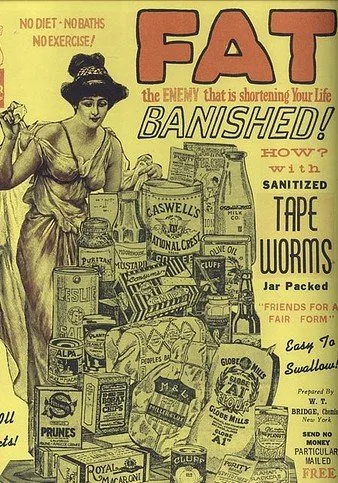
Tapeworm
Year: 1950s
Oh, the great tapeworm slim down – probably the most disgusting and silliest diet idea on this list. While most of us would gag at the thought of a parasitic worm inside our bodies, people in the 1950s thought it would be a great weight loss plan. It allowed an all-you-can-eat diet with zero food restrictions. After swallowing a baby tapeworm pill, the parasite would eat and grow up to 30 feet inside the dieter’s intestines. Once you were done “dieting,” you would take an anti-parasitic pill that would kill the tapeworm. Then you would pray to successfully poop it out without any abdominal or rectal complications.
Sleeping Beauty
Year: 1960s
Another truly ridiculous diet method combines the two things humans love most: eating and sleeping. The sleeping beauty diet consisted of popping a few sleeping pills whenever you were hungry to avoid eating. Dieters were told to do this for about a week or so. The method to the madness? While you’re sedated, your body will be forced to shed stored fats. Elvis was actually a huge fan of this sleeping fast towards the end of his life when he no longer could fit into his infamous jumpsuits. There aren’t many studies that support this diet… in fact, there are none at all. Shocker.

Stone Age/Paleolithic
Year: 1970s

Let’s go back to the cuisine of our hunter-gather ancestors: meat, meat, nuts, berries, and did I mention meat? This regime as a diet plan became mega popular after Walter Voegtlin published his book The Stone Age Diet in 1975, arguing that our bodies are biologically programmed to eat like our caveman predecessors. In this Stone Age Diet, foods pumped with processed oils are a big no, as are dairy, grains, and beans. Lean and grass-fed meats are the main staples.
Personally, while I don’t think switching my morning dairy yogurt to coconut yogurt is a big deal if it means shedding a few quick pounds, I would never want to give up beans (hey, they’re a great source of protein!) This program wasn’t entirely ridiculous: cutting out dairy lowers your risk for common modern diseases such as obesity and heart disease. The ridiculous part is that animal protein (meat included, of course), has been proven again and again to dramatically contribute to obesity, diabetes, cancer, and a range of other health issues!
Cabbage Soup
Year: 1980s
Nobody really knows where this craze came from. It is said that it became trendy through faxlore – which is basically junk mail through fax machines (remember those?). Most nutritionists are vehemently against this 1-week extreme dietary program, since dieters cut out important nutrients, don’t receive enough calories, and only lose water weight. And why cabbage? It’s not particularly nutrient-dense. Also, aren’t you going to get bored with only eating cabbage soup? And who even likes cabbage soup?
South Beach
Year: 2000s
Instead of limiting calories, this Miami-based trend educates dieters on “good” and “bad” carbs and “good” and “bad” fats. Developed by cardiologist Dr. Arthur Agetston, the South Beach Diet is like the heart-healthy sister of the Atkins Diet, the acclaimed low-carb diet. Originally the regimen was created to prevent heart disease, but became widely known as a weight-loss plan after Dr. Agetston published his book in 2003. The South Beach Diet isn’t about low-cal and low-carbs — it’s about choosing healthier food and normalizing portions (lessening your American-sized meals). My favorite part: snacking is encouraged.
Most nutritionists are vehemently against this 1-week extreme dietary program, since dieters cut out important nutrients, don’t receive enough calories, and only lose water weight.
Juice Cleanse
Year: 2010s

We’ve took a look at all the bizarre, disgusting, unhealthy, and controversial diets trends of the past. Now, we’re back to the liquid-only craze, embedded deep in the era of the juice cleanse. These cleanses promise to clear the body from toxins by drinking a few pre-bottled juices per day. On their own, I love these juices. They’re delicious, easy to take on the go, and highly nutritious. I feel fresh after my green drink, despite the weird looks I get sometimes, but I’ve never tried a 7-day intense juice only regimen. Its benefits aren’t proven, and professionals think it’s potentially hazardous. And anyway, who knows? Maybe someday this will be just another outrageous diet.
Plant Based
Year: 2020s
Vegan is the new cool. After the success of films like Game Changers, Cowspiracy, and What The Health, this diet has really taken off. It’s way better for your health, way better for the planet, and all the cool kids are doing it. The nay-sayers say you need supplements when you’re on a plant-based diet or you’ll be B12 deficient, which is true, but most meat-eaters are also B12 deficient these days because of issues with factory farming. Despite that, the evidence is there that this is the healthiest diet for the human body, when done right. That means lots of veggies, legumes, grains (no, I don’t mean white bread!), and fruits. That, plus try to lay off the processed food, pasta, bread, and sugar (I know, that’s the hardest part!) and you’ll feel better than ever before.






I don’t know whether fad diets are safe over the longer term, or whether they lead to an increased risk of various diseases. It’s risky!
You may be looking for a fast way to lose weight and there’s no shortage of fad diets around. But these diets may provide short-term results, but they are difficult to sustain and ultimately, they deprive you of the essential nutrients that only balanced eating can offer.
When you’re trying to lose weight, it can be tempting to fall for the promises of a fad diet. Many of them will allow you to lose weight quicky but the methods these plans use to allow you to lose weight so quickly are often unsafe and can put your long-term health at risk. I know because I’ve been there. I used to follow Keto diet but my gout became worse because I overindulge in red meat.
Some fad diets can be dangerous because of their very low calorie levels, and the poor nutrition they promote. So I prefer going for a balanced diet with exercise.?
Likewise! You won’t lose weight with just a diet plan you also need to workout!
Lose weight the right way! Don’t compromise.?
Great article! I was searching for the same form some time ago , glad I found this blog.
“Fad diets may help you lose weight but they are just a short-term fix. Say no to fad diets and start examining your current eating habits and make a commitment to swap them for healthier ones. ??
“
Sure, losing weight is better for your health, but there is a way to go about it that is good for you and many ways to achieve weight loss that could hurt your body in the process. When you follow a fad diet that isn’t focused on your total health and only on weight loss, there is a greater chance that it just might negatively affect your overall well-being. Still best to do some research and seek advice from a Doctor. ?
Thanks for these diet ideas. I guess I just have to pick the best one for me. ?
Even if you are able to achieve a large weight loss on the fad diet, chances are good that it isn’t actually fat that you shed. Normally, it is water loss, that is registering on the scale and if it very strict over a longer period of time, it could be muscle loss too.