
Whenever I flip through a mainstream magazine like Cosmo, Elle or Vogue, I feel invisible.
The models don’t look like me, the advice about sex and relationships seem to focus on convincing women to contort themselves into what men want, the fashion is outrageous and ridiculously expensive, and there’s absolutely no talk about intellectual pursuits, women’s rights, or what it’s like being a gay or African-American woman. It all makes me feel like a complete outsider!
Until recently (thank you, Shonda Rhimes!), these magazines were a part of a bigger problem for me. The media, television, movies, and advertising completely ignored women like me. Even magazines that were supposed to be for and about women weren’t seeing me at all.
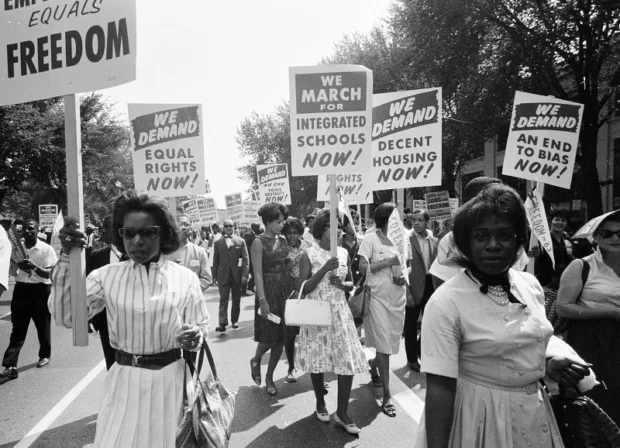
Like me, many women feel they are invisible. When we want to say “hello, my body is my body and you can’t make legislation around it,” we’re sometimes not heard. When we stand next to a billboard of a skinny, white, bikini-clad model (with cartoon-like thigh gap, of course), we feel like unseen outsiders. It’s like women are only seen as a collective of highlights, blow-outs, mini-skirts, and high heels instead of individuals with ambitions, intellect, and talent. There’s a high IQ under this mass of curls, and I wish society would recognize that.
Ladies, if you’ve ever felt invisible or unheard (and I know you have!), you may relate to one of my favorite books: Invisible Man. In this audiobook from Audible, the narrator, known only as Invisible Man, starts out at a “model young black man”. After numerous disappointments and setbacks under the authority of white leaders, he joins an African-American brotherhood. There, he finds solace and understanding — finally! Later, he encounters more disenchantments when he discovers that The Brotherhood has used him, so he goes underground, literally… (he falls into a manhole and decides that maybe this is a better place for him while he decides on his next move.) I don’t know about you, but I’ve definitely felt like burying my head in the sand a number of times over the years.
Although African American and women’s issues are not always the same issues, I think we can all agree that woman — especially minority women — have seen some of the harshest treatment, and have fought some of the biggest civil rights battles. Oftentimes, there is an overlap between these two groups when it comes to invisibility.
I can relate intimately to the struggle of the Invisible Man, as I have often felt like an Invisible Woman.
When I was younger, I was taught (like many other young girls) that I should be a “model young woman.” In my life, this translated into trying way too hard to not only look like a model, but to put almost all of my self-worth in my appearance and demure disposition.
However, after plenty of disappointments and frustrations under a male-dominated society, I found solace in feminism. That’s when I grew comfortable in my own skin and gained a much-needed perspective. But I was luckier than the Invisible Man. Instead of feeling manipulated by the feminist movement, I found empowerment. After regrouping (fortunately not in a manhole), I started writing for Urbanette, where I could share ideas about women’s empowerment, and where I could help other women find their voices and become visible.

Author, founder, and CEO of Audible, Don Katz, had much the same experience when he took classes at NYU taught by Ellison, and received support from Ellison when he began his career as a writer.
“Ralph Ellison conveyed that in a nation creating itself without kings, a new order was created based on the color of people’s skin,” explains Katz. Then, in an optimistic tone, he continues by stating that, “the American experience is derived from the process of a nation constantly making and remaking itself. A place that needed to create its own myths and art, even its own sounds, because we had to.”
So as America continues to remake itself, our hope at Urbanette is to create a space where women can remake themselves as strong, empowered individuals. Let us invent our own myths, art, and sounds specific to the visible woman.
Katz had the same instinctive urge as I did when I started writing for Urbanette. We were both empowered by the strong, resilient voice of Ellison. Katz wanted to provide a platform where everyone could glean inspiration from the unbridled power of the well-spoken word. Most of all, he wanted to create a service that could help people find themselves through the spread of ideas and, in so doing, become a visible individual.
I hope that you fall in love with this audiobook as much as I did and let it inspire and empower you to become a Visible Woman. Download it now for free on Audible!



I love Audible so much. Saves a lot of time in reading by just listening to it.?
I really love articles written by Angela Davis. I really sympathize with her works and I understand her from the depths of my heart. I do feel invisible at times, just like what you said. But the term I would like to accurately describe what I feel is the feeling of being worthless amongst all the talk about feminism and women, overall. I feel like I’m in a body that I don’t belong… Like I can’t even recognize who I am because I’m bombarded by images that I can’t be.
Great e-book, read that before and it was a 4.5 out of 5 for me.
I’ve felt invisible in the past, but it’s a phase that we all have to go through.
The solution is to approach someone in your family whom you trust, tell them how left out you feel and ask how you are viewed by the family. In other words, discover which box you have been placed in. Once you have a reasonable answer, you can begin to change their perception. If you are seen, for example, as quiet, accepting, unobtrusive and useful only when others need something from you, turn the tables. Start talking, speak up for yourself and ask others to help you for a change.
We can be whoever we want to be in this world. Let’s not choose to be weak.
I feel this way sometimes and I hope we can all find our sense of purpose. Yes, we are all smart and talented women and not just a pretty face. But it’s so easy to get lost and feel invisible in a world full of people like this.
I love Urbanette. It tackles a lot of issues that need to be truly voiced out.
The Invisible Man is a great read. As always, thank you for sharing. I hope some of you take the time to read it. It’s highly relatable.
The Invisible Man is a great read. Thanks for sharing this Audible. I’m enjoying a lot of posts here on Urbanette that suggests them.