
If you thought bleeding from your nether regions for a week every month was bad, imagine if you had to spend this week sleeping on the hard floor of an outdoor hut…
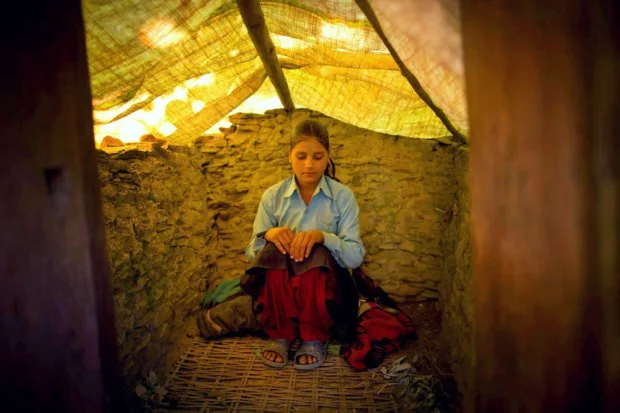
In some regions of Nepal, this is a reality. The villagers who practice this tradition, known as ‘Chaupadi’, believe that a menstruating woman will anger the Hindu gods or contaminate the home if they remain indoors when Aunt Flow comes to pay a visit. They go each night to their “menstrual huts” for fear that livestock or family members may get sick or die.
In the west Nepal village of Timalsena, 26-year-old Dambara Upadhyay was no exception. On November 18th, 2016, Upadhyay slept in a menstrual hut, and on the morning of November 19th, she was found lifeless. This is certainly not the first time that a woman has died in a menstrual hut, but it marks the first time that the prime minister requested an investigation of the incident. Almost exactly one month later, overnight on December 17th, a 15-year-old died when her hut burned down.
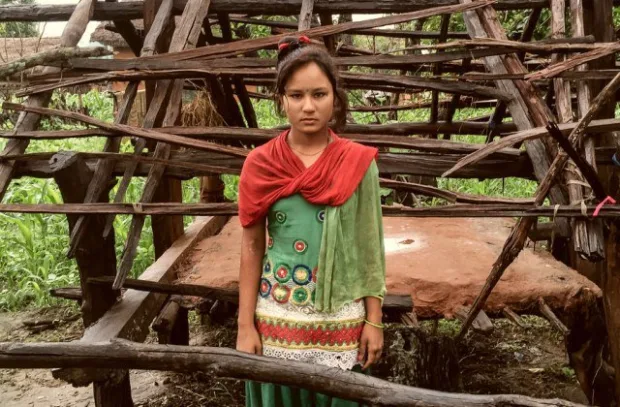
Despite the dangers, it’s not hard to see why this superstitious tradition continues. If, for generations you’ve been told that the evacuation of hemoglobin from your lady parts was connected to the death of your grandfather, you would be pretty quick to seclude yourself in an outdoor hut as well.
The practice has been outlawed since trucker hats were a thing (2005 in case you’ve wiped that tacky trend from your memory), but like many regions where modern life (and trucker hats) have yet to infect the populous, the tradition has continued. And even though Chaupadi was outlawed 11 years ago, there were no avenues put in place to prosecute violators, so the practice carried on unhindered. Following Upadhyay’s recent death, the Nepal Ministry of Women, Children, and Social Welfare has vowed to nip the issue in the bud by enacting laws designed to punish families who practice Chaupadi.
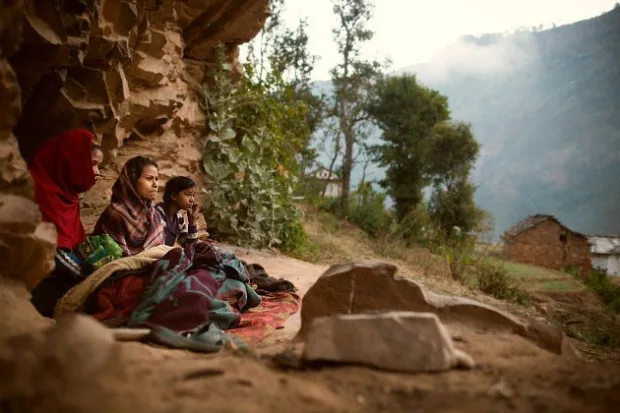
But, in the nearby district of Jumla, one man is attempting to change the practice another way. Through his organization, Surya Social Service Society, which promotes safe menstrual practices, he persuades local families to set up a secluded room inside the house for a woman to spend her time of the month, instead of a hut outside. Model families who have done this are then used to demonstrate to other still-suspicious families that grandpa will live to see another day, and that the crops and the livestock will keep producing as per usual.
To get involved in spreading awareness about menstrual health and save women’s lives, contact the Surya Social Service Society.






This is no longer a cultural issue but a human rights issue! Women all over the world are entitled the right to live with dignity, respect, and confidence.
This horror visited upon young women, particularly, makes me wonder what we (as non-Nepalis) can do to support the women and girls living through it. It also dispels the quaint, wistful, yet somewhat condescending notion that many of us carry of the bucolic bliss of “simpler” cultures.
Oh wow! Super scary! Menstruation is perhaps one of the most ordinary individual female experiences, but it feels like a CURSE in Nepal! Terrible ?????
Indeed! I’ve read CNN news wherein a woman was bitten by a snake while in her menstrual hut: https://edition.cnn.com/2017/07/10/asia/nepal-menstruation-hut-deaths-outrage/index.html
Very sad!
You can become anemic from blood loss during your period. If you soak up more than 2 pads in an hour, go to the ER.
Hi Hillary,
Upon reading this article, I felt mixed emotions: angry, sad and uncomfortable! We often talk about how, in many parts of the world, period stigma prevents girls from working or getting an education. Sometimes, though, taboos surrounding menstruation can even turn deadly. 🙁
While I appreciate the article, you do nothing for removing stigma by using pet names like ‘aunt flo’.. or making jokes about trucker hats… I would hope this was done in an attempted to soothe the topic to those still uncomfortable and unfamiliar. But if we want change, we must BE change.. it’s a period, menstruation, cycle,… it’s not ‘that time’ ‘aunt flo’ or ‘your friendly visitor’
Thanks.
This tradition has been part of history for as long as we’ve had written traditions–it is even mentioned in the bible. It is mindboggling that it is still being practiced in some parts of the world–but the article is right; if some women are told that their menstrual cycle related to any misfortunes in their life, they would immediately remove themselves from the situation. It is good to hear that the government is beginning to get involved and investigate the situation–it might help future deaths be prevented.
Reading this article gave me mixed emotions: angry, sad and uncomfortable! I feel bad that women from Nepal need to experience harsh treatment because of religious belief or cultural tradition!
I’d like to help and I’m exploring Surya Social Service Society’s activities. I’ll be involved!
I’m glad you liked the article! Thank you for wanting to become involved 🙂
This cultural tradition is sooooo dangerous and cruel!!! I think education plays a major role. I mean if women are educated in these places, do you think they would allow being treated this way?
If they are educated:
– they would know this practice would bring “health problems”
– they would be aware and would know what are and how to fight for their rights as women
I absolutely agree that education is the key to ending this practice. The people in these communities need to see that having a menstruating woman in the house will not impact the family in a negative way. Also, probably learning more about the science behind menstruation would be helpful as well.
This is but one “problem” that many communities around the world have held for centuries and still hold today with women; female genital mutilation is still practiced in some African and Middle Eastern cultures; breastfeeding, the natural way for a human to feed offspring, continues to be vilified. So, the enjoyment of sex (FGM) and the ability to bear children (menstruating) and feed them (breastfeeding) are all bad and need to be punished. Unconscionable.
Such an eye opener. Thanks for writing about it! Chaupadi clearly illustrates the negative side of “religion.”